

Sparassis crispa (Cauliflower Fungus): Health Benefits & Medicinal Uses
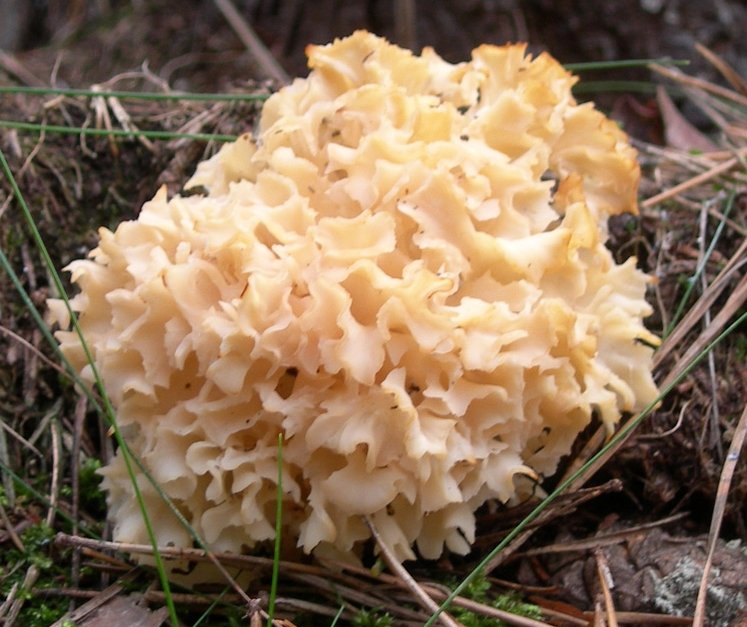
Sparassis crispa, commonly known as the cauliflower mushroom, is a distinctive species of saprophytic mushroom characterized by clumps of wavy, flattened, leafy or ribbonlike lobes arising from a thick rooting stem that attaches deeply into its substrate. This species is also known for its edibility and purported medicinal properties.
This mushroom species was originally described by the German mycologist Julius Schäffer in 1772 as Elvela ramosa and then again in 1781 by the Austrian botanist and Jesuit priest Franz Xaver Freiherr von Wulfen as Clavaria crispa. In 1821 this species was reclassified under the genus Sparassis by the great Swedish mycologist Elias Magnus Fries in his publication of “Systema Mycologicum”. Since then, modern research into the morphological and molecular analysis of the specimens of Sparassis crispa from different corners of the world has shown that they are distinct from one another. As such, newer species such as the North American Sparassis americana and Sparassis radicata and the Asian Sparassis latifolia have been created, while Sparassis crispa is now a strictly European species. However, as most mycological sources are not up to date, this overview will discuss and describe Sparassis crispa in the broad sense unless otherwise specified.
The etymology of this species is straightforward. The generic name Sparassis comes from the Greek word meaning “to tear” referring to the irregular fronds of the mushroom’s fruiting body. While the epithet crispa references the waviness of the fronds and not their crispness.
Identification and Description
Fruiting Body: 5-20 cm tall, 6-30 mm across, although it can be even bigger, and sometimes reach a weight of 6 kg. Its overall shape is irregularly spherical or elliptical, with a thick, fleshy base from which leafy branches grow and develop. The branches are partially fused, both sides are covered by hymenium. The surfaces of the branches are smooth, whitish to creamy or yellowish, often becoming cinnamon in age or dry weather, sometimes with darker brown stains on the edges. Branches of younger specimens are brittle, while older specimens have tougher, pliant branches. The edges of the wavy or curled lobed leaves are toothed. At first they are whitish, later yellowish and when old they become orange-yellow to yellowish-brown. The base of the stipe is almost black.
Flesh: waxy, flexible, white, with a pleasant smell, tastes nutty, according to some references.
Stalk: S. cripsa has a relatively short and stout stem that typically measures 5–13 cm in length and 2-5 cm in thickness, and is buried deep into the substrate (ground or wood). It is composed of dense and tough mycelial tissue, which supports the weight of the fruiting body and has a slightly rough texture due to the presence of tiny fibrils or fibers on its surface.
Spore print: yellow to yellow-orange.
Spores: 5-7 x 4-5 µm; elliptical, with big fat drops.; smooth; light yellow.
Odor: This species has a mild, fragrant spicy to sweet smell that is said to be characteristic but difficult to characterize. Some reports suggest that it smells like hazel or walnuts.
Edibility: This species is considered edible by all mycological sources and as a choice edible by some. Specimens should be young and fresh. Readers should be aware that these mushrooms are very difficult to clean as a lot of gunk and debris gets deposited between their wavy branches. As with all mushrooms they should be properly cooked by sautéing or boiling followed by baking or stewing prior to consumption.
Habitat: S. cripsa is parasitic and grows solitarily on the roots or trunk bases of coniferous trees, most commonly Scots pine but also oak, spruce, cedar, larch, and others.
